Customerstorefront
A refined shopping environment covering product discovery, refined detail views, and seamless cart interactions. Built for clarity and a calm browsing pace.

A production oriented fashion ecommerce platform built as a modular monolith, combining a premium storefront experience with dependable backend workflows for catalog, checkout, promotions, admin operations, customer accounts, and replay safe wishlist processing.
Role
Fullstack Developer
Project type
Fashion ecommerce platform
Stack
Next.js, TypeScript, Prisma, PostgreSQL, Supabase Auth, Cloudflare R2, Upstash QStash
01 - Case Study
Overview
Moethuzar was designed as a production oriented ecommerce platform with both customer and operational workflows in mind. On the frontend, it needed to feel clear, premium, and easy to navigate. On the backend, it needed to support the realities of commerce, including product variants, inventory, promotions, guest and authenticated users, manual payment flows, order tracking, and admin operations.
Rather than treating the project as a collection of pages and forms, I approached it as a full product system. That meant designing the customer experience, shaping internal tools, and building the backend architecture that made the whole platform stable, maintainable, and ready for real usage.
Visual story



Capabilities
A refined shopping environment covering product discovery, refined detail views, and seamless cart interactions. Built for clarity and a calm browsing pace.
A mission-critical orchestration handling real-time stock verification, shipping resolution, and idempotent order creation with manual payment reconciliation.
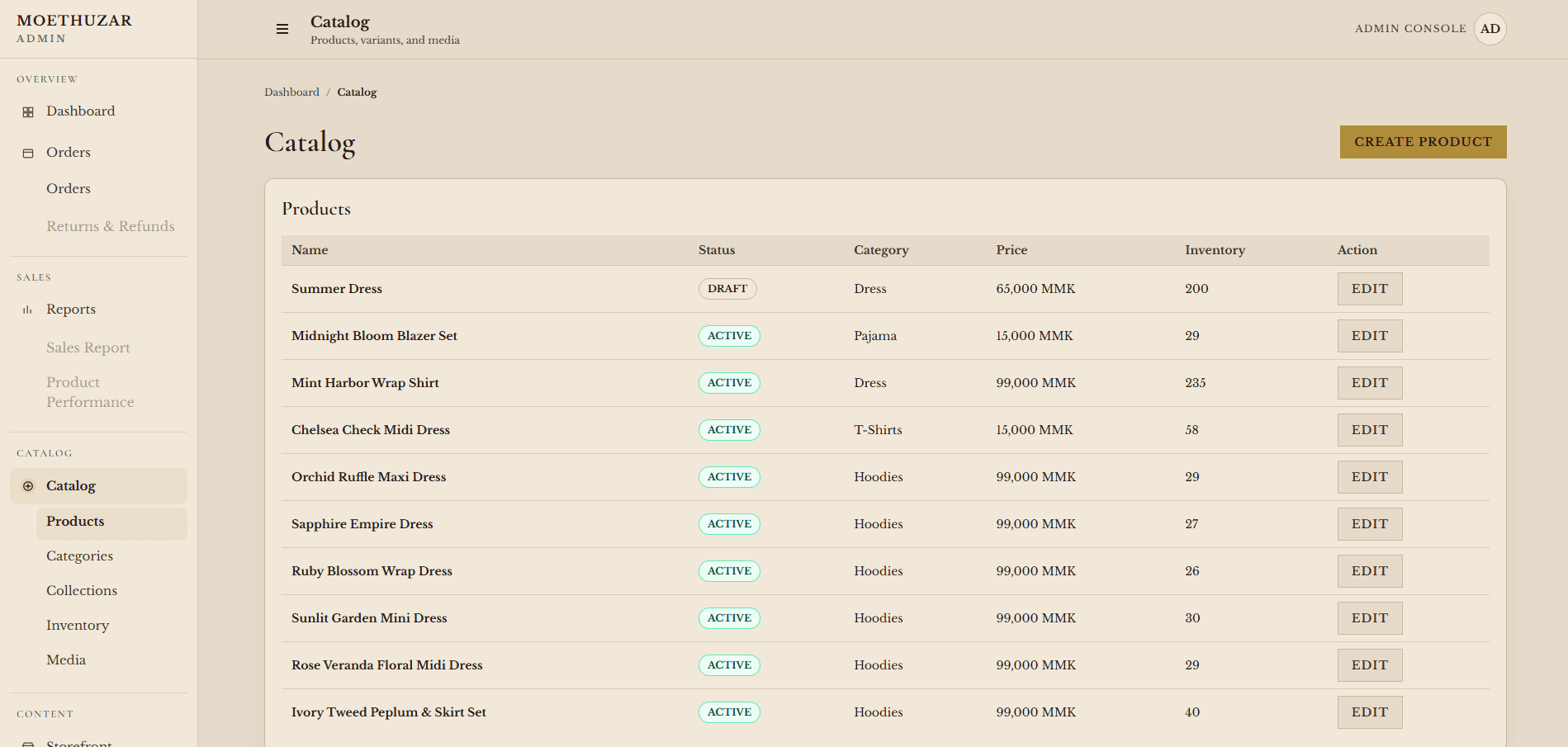
Internal management surface for catalog control and promotion logic. Treated as a first-class product interface, not a utility afterthought.
A replay-safe architecture built around canonical write data and queue-based delivery using QStash for production-grade reliability.
Architecture
I structured the backend as a domain oriented modular monolith. The goal was to keep the system cohesive and practical while still maintaining clear boundaries between transport concerns, business workflows, domain logic, and specialized persistence.
API routes stayed thin and focused on request parsing, auth or session resolution, validation, and error mapping. Services owned use case orchestration and transactional behavior. Domain modules captured important rule logic in isolation. Repositories were used selectively where persistence complexity actually justified an abstraction rather than being applied everywhere by habit.
Thin transport layer
app/api/*
Request parsing, validation, auth or session context, rate limiting, delegation to services, stable API responses
Rich use case services
server/services/*
Business workflow orchestration, transaction coordination, use case logic, integration across rules and data sources
Requirements driven
Architecture follows actual domain complexity.
Operational realism
Idempotency and recovery as first-class citizens.
Domain rules
server/domain/*
Pure business logic, isolated rule modeling, deterministic logic where appropriate
Persistence
server/repositories/*
Specialized query logic, projections, and selected data access complexity where abstraction actually added value
Moethuzar v1.0 / Architecture schematic
PostgreSQL - Prisma
Deep dive
Architecture focused on rigorous backend orchestration. We ensure transactional dependability through strict cart validation, inventory integrity, and pricing snapshots within a unified transaction boundary.
System orchestration
Transactional Order Flow
Step 01
Cart validation
Step 02
Inventory check
Boundary
Transaction
Step 03
Pricing snapshot
Step 04
Order creation
Deep dive
Leveraging a transactional outbox pattern to achieve absolute eventual consistency. User interactions are committed as durable outbox events within the same transaction as the canonical write model.
Write model
Outbox
QStash
Read model
Deep dive
Internal tooling designed with the same performance and aesthetic rigor as the primary storefront.
842
+12%
Commerce domain model
Moving beyond simple CRUD patterns to a domain-oriented service architecture. We built a system that separates canonical write data from derived view models, ensuring that variant-level inventory and order lifecycle states remain immutable and auditable.
Domain model map v0.1
Ref. Project: Moethuzar
Scale 1:50 / R01
Catalog
Order lifecycle
CartItem
OrderItem
Wishlist async model
WishlistItem
Canonical write
EventOutbox
Durable ledger
WishlistItemView
Derived read model
System truth architecture
Canonical state persistence
Inventory architecture
Variant-level inventory modeling tailored for apparel commerce, supporting complex SKU hierarchies and real-time availability locks.
Durable ledger
An event-based outbox pattern ensures wishlist replay safety and async read/write separation via a durable system ledger.
Reliability and security
One of the most important goals in this project was making the backend trustworthy, not just functional. That meant designing critical workflows with clear boundaries, handling abusive or duplicate behavior carefully, and keeping recovery paths available for asynchronous features.
Guardrail v.03 (Security)
Request level rate limiting
Guest and authenticated identity boundaries
Sanitized redirect handling
Minimal auth payloads
Abuse controls around account precheck flows
Recovery v.04 (Reliability)
Idempotent order creation
Transactional order workflows
Durable outbox pattern for async events
Idempotent projection updates
Rebuild path for derived wishlist state
Structured error envelopes and request IDs
Rollback aware async delivery planning
These are the details that separate a polished demo from a system that was designed with real usage in mind.
Engineering principles
I did not try to force one architectural style across the entire system. Instead, I used stronger patterns where the domain actually demanded them and kept simpler flows straightforward where complexity was lower.
01
Canonical truth over duplicated state
02
Patterns only where complexity justifies them
03
Thin transport, rich use case services
04
Server first rendering with isolated client interactivity
05
Operational reliability designed in, not bolted on
06
UX upgrades without destabilizing backend contracts
07
Internal tools treated as product surfaces, not afterthoughts
Delivery methodology
Process strategy
This project was developed as a set of vertical slices rather than as separate frontend and backend tracks. That kept product features coherent and helped ensure that interface decisions and operational workflows evolved together.
Focusing on delivering end-to-end features rather than technical layers, ensuring value is visible early.
Tackling the most complex and high-risk integrations first to stabilize the core architecture.
Maintaining live architectural documents and QA notes to guide implementation as the system scaled.
Deeply testing service logic and security-sensitive flows instead of superficial metric chasing.
Designing asynchronous features with built-in recovery paths and operational visibility.
Challenges and solutions
The project included several challenges that pushed it beyond simple ecommerce implementation. The most important ones were about identity, backend workflow complexity, and system stability.
Challenge 01
Supporting both guest and authenticated user journeys cleanly.
Resolution
Implementation of unified service boundaries that treat the user context as a transient property rather than a hard database divide.
Challenge 02
Handling localized payment flows across varied providers.
Resolution
Utilization of canonical database models to normalize heterogeneous provider responses into a stable internal contract.
Challenge 03
Keeping wishlist updates durable without coupling reads to writes.
Resolution
Transactional outbox records with projector-driven read models preserved eventual consistency without losing replay safety.
Challenge 04
Extending admin capability without damaging maintainability.
Resolution
Operational surfaces were treated as bounded product areas with explicit service ownership rather than generic dashboard utilities.
Challenge 05
Improving account UX without redesigning the underlying auth foundations.
Resolution
A staged interface layer was added above stable backend contracts so the customer flow could improve without destabilizing identity logic.
Final frame
The Moethuzar case study — 2026